

What the history of computing teaches us about the future beyond artificial intelligence
By Juan Carlos Suarez
Founder & CEO, TBQ Computing™
Independent Researcher & Inventor
Introduction — Understanding the Next Technological Wave
This article is written primarily for readers who are not specialists in quantum computing but who recognize that a new technological transformation is taking shape. Its purpose is not to explain quantum physics through complex mathematical formulations, but to offer an accessible perspective on why quantum computing matters, how it relates to the technological revolutions that preceded it, and what its development could eventually mean for individuals, businesses, industries and society.
Most of us use technologies every day without fully understanding the scientific principles that make them possible. We do not need to understand semiconductor physics to use a smartphone, nor must we master artificial intelligence algorithms to benefit from their applications. Quantum computing may follow a similar path, although significant scientific and engineering challenges remain before its capabilities can become widely accessible and commercially useful.
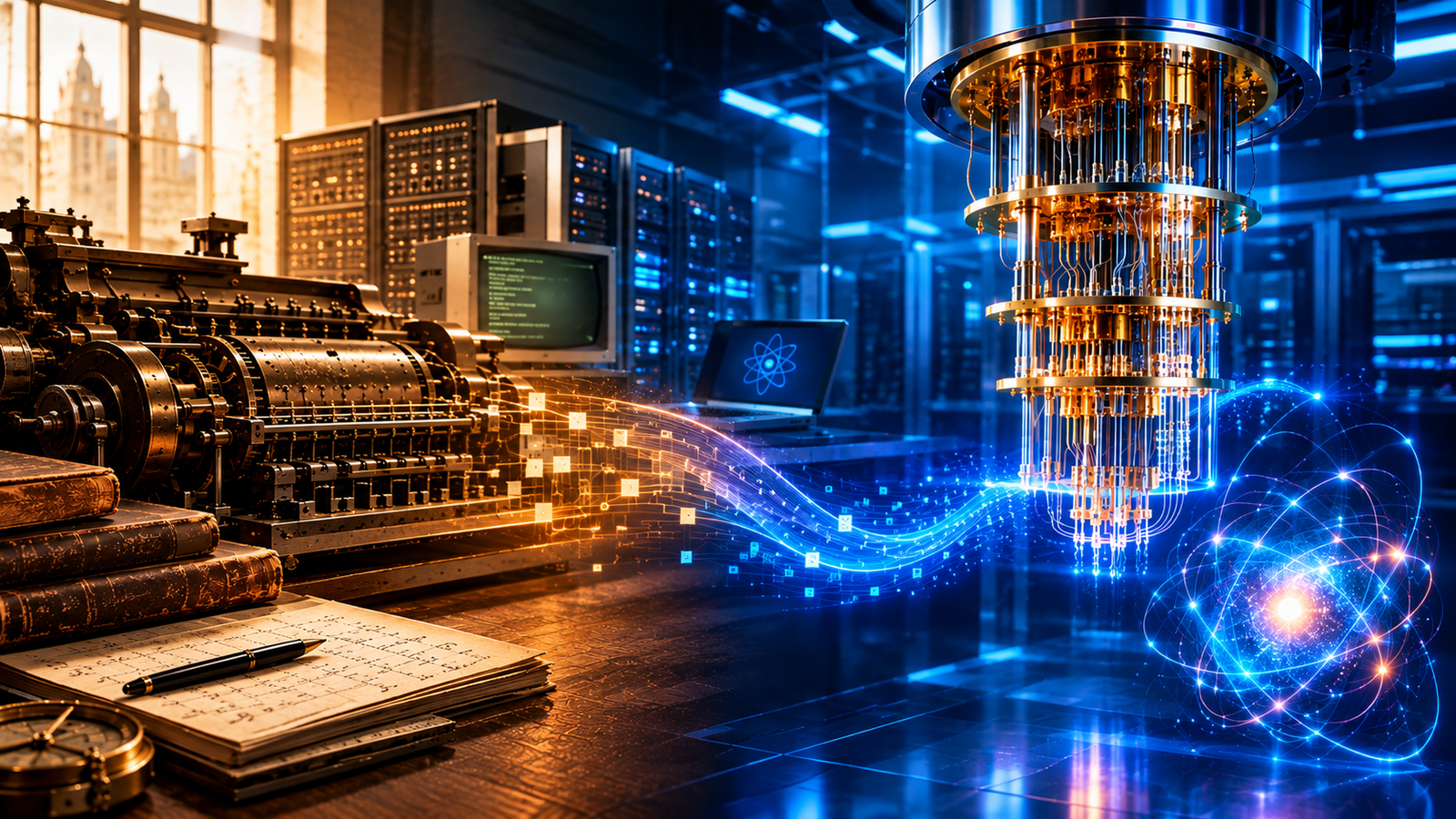
Throughout history, major advances in computing have emerged from humanity’s need to overcome existing limitations. From the abacus to electronic computers and artificial intelligence, each generation has introduced new instruments that extend what the human mind can accomplish. Quantum computing represents another potential expansion of those capabilities, not necessarily by replacing the technologies we already use, but by introducing fundamentally different ways of processing information and solving certain classes of problems.
At TBQ Computing™, we believe understanding this evolution should not be limited to physicists, mathematicians, engineers or quantum researchers. Entrepreneurs, investors, business leaders, students and curious readers also have an important role in recognizing the opportunities, limitations and practical consequences of emerging technologies.
This article therefore explores the parallels between classical and quantum computing, the necessity that has historically driven technological innovation, and the distinction between scientific breakthroughs and technologies that create genuine economic value. It also introduces a broader question guiding our long-term research: what limitations will remain after artificial intelligence reaches capabilities that today may seem extraordinary, and what new computing tools might humanity need to overcome them?
The intention is neither to suggest that quantum computing has already fulfilled all its promises nor to present speculative research as established scientific fact. Rather, it is to invite readers to understand an emerging technological frontier through the lessons of history, the discipline of scientific evidence and the possibilities of human ingenuity.
Because the next technological revolution should not be understood only by those who build it. It should also be understood by those whose future it may transform.
The Origins of Computational Progress
The history of computing is not simply a history of increasingly powerful machines. It is the history of humanity identifying limitations in its ability to calculate, understand, predict and manipulate the physical world, and subsequently developing technologies capable of overcoming those limitations.
From the abacus to artificial intelligence, each major transformation has expanded the effective intellectual capabilities of the human brain without requiring an equivalent transformation of its biological structure. What has evolved most dramatically is not the human brain itself, but the computational instruments through which human intelligence interacts with information and reality.
This historical perspective becomes particularly important as we consider the development of quantum computing and ask a question that may eventually define another technological transition: What will humanity need when artificial intelligence, however sophisticated, is no longer sufficient?
Classical Computing: Overcoming the Limitations of Calculation
Early computational instruments, including the abacus, emerged from practical needs involving commerce, measurement and arithmetic. Mechanical calculators subsequently automated increasingly complex mathematical operations, while the development of formal logic and programmable machines established the conceptual foundations of modern computing.
During the twentieth century, electronic computing transformed these foundations into physical machines capable of executing calculations at speeds and scales unattainable through manual methods. Semiconductor technology, integrated circuits and microprocessors progressively reduced the cost and physical dimensions of computation while expanding its accessibility.
The development of digital networks introduced another transformation. Computing was no longer confined to isolated machines; information and computational resources could be exchanged across organizations, countries and eventually the world.
Artificial intelligence represents a further development within this progression. Rather than merely executing explicitly programmed instructions, modern AI systems can learn statistical relationships, generate representations, assist with reasoning, develop software, analyze complex information and participate in scientific and engineering workflows.
The underlying historical pattern remains recognizable: an existing computational capability encounters limitations, and human ingenuity develops new methods to extend it.
Quantum Computing: A Different Response to Computational Limitations
Quantum computing emerged from a different but related necessity. As researchers investigated the computational requirements of simulating physical systems, it became evident that certain quantum phenomena were exceptionally demanding to represent using classical computational methods.
Richard Feynman’s early proposals concerning quantum simulation and David Deutsch’s subsequent formulation of a universal quantum computer helped establish the foundations of a computational paradigm based directly on quantum-mechanical principles.
Unlike classical bits, quantum information can be represented through quantum states exhibiting superposition and entanglement. Quantum algorithms exploit interference and other quantum properties to perform particular computational tasks in ways that differ fundamentally from classical approaches.
The development of Shor’s factoring algorithm and Grover’s search algorithm demonstrated that these differences could have important computational consequences. Later advances in quantum error correction, superconducting circuits, trapped ions, neutral atoms, photonics and other architectures transformed quantum computing from a predominantly theoretical discipline into an expanding experimental and engineering field.
Yet the historical parallel with classical computing contains an important distinction.
Classical computing achieved broad commercial adoption through successive improvements in reliability, programmability, cost and practical utility. Quantum computing is still confronting substantial challenges involving noise, error correction, scaling, resource requirements and the demonstration of economically meaningful advantages.
A quantum processor does not become commercially valuable merely because it exhibits nonclassical behavior or performs an impressive experimental benchmark. Its value ultimately depends on whether it can deliver a useful capability under realistic technical and economic constraints.
The Convergence of Classical Computing, AI and Quantum Technologies
The future of computing is unlikely to emerge from the complete replacement of one paradigm by another. Classical computing remains essential to artificial intelligence, and classical processors also perform indispensable functions in quantum-system preparation, control, calibration, measurement and analysis.
AI is increasingly becoming an instrument for the development of computing itself. It can assist researchers in exploring architectures, identifying potential failure modes, optimizing control parameters, developing simulations and examining experimental results.
This introduces a recursive relationship into technological development: humans created computational instruments, those instruments enabled artificial intelligence, and artificial intelligence can now participate in creating the next generation of computational technologies.
At TBQ Computing™, we express our approach through a fundamental principle:
COMPUTING MADE WITH AI, NOT BY AI.
This distinction does not deny the substantial intellectual contributions that AI systems can make. It emphasizes human responsibility for research objectives, engineering decisions, scientific validation and the consequences of technological deployment.
Scientific Validation and the Creation of Economic Value
The historical development of computing also demonstrates that scientific possibility and commercial utility are different milestones.
A new architecture must first establish that its proposed capability is physically and mathematically sound. It must then demonstrate reproducibility, withstand competing explanations and show measurable utility under relevant conditions.
Only afterward can questions of manufacturing, scalability, intellectual-property protection, licensing, customer adoption and economic value be answered credibly.
For TBQ Computing™, this distinction is central to our research strategy. Our investigations into temporal-boundary quantum processes seek to determine whether particular arrangements of measurement, information availability, quantum operations and computational control can yield differentiated capabilities beyond appropriately matched conventional explanations.
These investigations do not assume that a new temporal computational resource has already been demonstrated. Their purpose is to determine whether such a resource can be defined, experimentally distinguished and ultimately engineered.
Our guiding standard is that scientific validation is not the finish line. It is the foundation upon which useful technology can be developed.
Looking Beyond Artificial Intelligence
Every major computational transformation has addressed limitations inherited from previous technologies. This raises a question that deserves serious investigation: what limitations will remain even if artificial intelligence becomes extraordinarily capable?
Potential constraints include energy consumption, computational complexity, physical measurement, reliability, verification, information accessibility and the distinction between predicting future events and obtaining information that is not yet physically available.
Some of these limitations may be reduced through better algorithms, more efficient hardware or new architectures. Others may arise from fundamental physical principles that cannot be overcome simply by increasing computational intelligence.
For TBQ Computing™, the long-term research opportunity lies in identifying these boundaries and investigating whether new computational resources can be developed to address them.
Temporal-boundary research, including the study of a specified future boundary T_f, represents one speculative candidate within that broader agenda. Its scientific legitimacy depends on distinguishing any proposed capability from established quantum conditioning, postselection, ordinary causal dynamics and other conventional explanations.
The objective is not to declare that future-boundary computation is possible. It is to determine whether physics permits a genuinely differentiated resource and, if so, whether that resource can be transformed into a practical computing technology.
The Next Human Step
The history of computing offers no guarantee that any particular technology will define the next era. It does, however, demonstrate humanity’s remarkable capacity to identify constraints and construct new instruments that expand what becomes possible.
Artificial intelligence may substantially transform engineering, mathematics, physics and scientific research. It may also reveal limitations that increasingly powerful intelligence alone cannot resolve.
That is where the next research frontier may begin.
At TBQ Computing™, our long-term purpose is to identify the fundamental limitations of existing computational paradigms and investigate the technologies capable of overcoming them. Our ambition is to convert validated research into defensible intellectual property, practical capabilities and lasting economic value.
The question is not simply whether artificial intelligence will become more powerful. It is what humanity will need when greater intelligence alone is no longer the answer.
Find the limitation, and we find the future of computing.
And when that future cannot yet be predicted, we begin the scientific and engineering work required to determine whether we can create it.
⸻
TBQ Computing™
Temporal Boundary Quantum Computing
www.tbqcomputing.com
Disclosure: This article was developed under the author’s direction, with AI assistance in research analysis, adversarial criticism, drafting and editorial refinement. The author retains responsibility for the final arguments and conclusions.
Selected Foundational References
- Turing, A. M. (1936). On Computable Numbers, with an Application to the Entscheidungsproblem. Proceedings of the London Mathematical Society.
- Feynman, R. P. (1982). Simulating Physics with Computers. International Journal of Theoretical Physics.
- Deutsch, D. (1985). Quantum Theory, the Church–Turing Principle and the Universal Quantum Computer. Proceedings of the Royal Society A.
- Shor, P. W. (1994). Algorithms for Quantum Computation: Discrete Logarithms and Factoring. Proceedings of FOCS.
- Grover, L. K. (1996). A Fast Quantum Mechanical Algorithm for Database Search. Proceedings of STOC.
- Preskill, J. (2018). Quantum Computing in the NISQ Era and Beyond. Quantum.
#TBQComputing #QuantumComputing #ArtificialIntelligence #ComputingHistory #QuantumResearch #FutureOfComputing #TechnologyInnovation